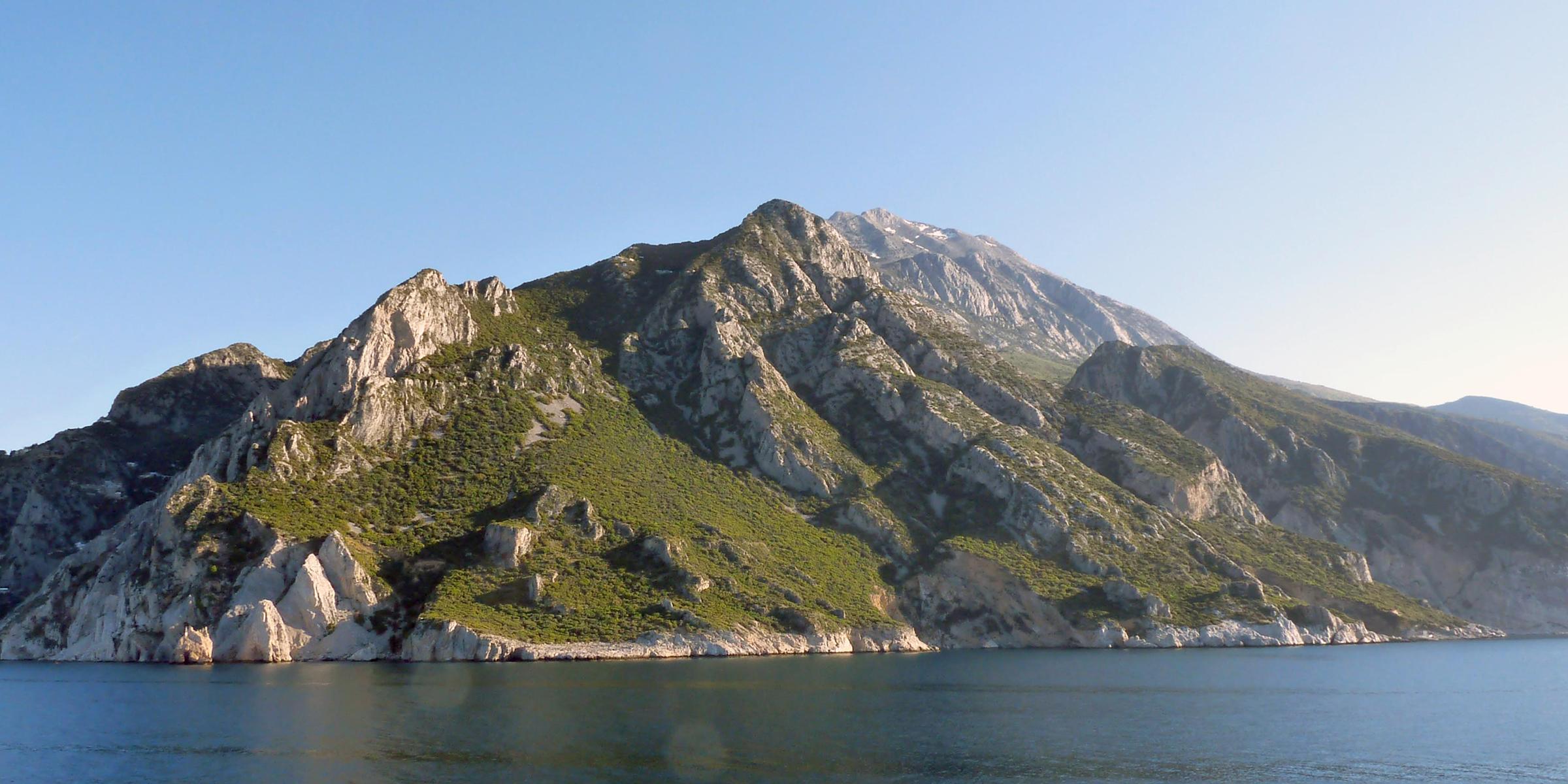
Mount Athos (2033m) or Holy Mountain (2033m) is Greece’s 48th tallest mountain and is located on the homonymous peninsula of Chalkidiki in Macedonia. The mountain is of unrivalled natural beauty, and due to its lack of infrastructure, offers a unique remoteness, especially during the winter.
Athos (2033m) was named after a giant who fought against Poseidon, after all, the mountain’s effects on sea conditions was known during ancient times, with a mention within the Iliad, and the Persian general Mardonius having lost 300 ships near it. Settlement of the broader area peaked during the Hellenistic period with five cities being recorded, however, lack of later mentions suggests the likely abandonment of the area until the monks settled during the 9th century.
Today Holy Mountain is considered one of the most important living cultural monuments in Greece and has been designated as a UNESCO World Heritage Site since 1988. Even though it is a popular destination for ecclesiastical tourism, the difficult access and sparse habitation have retained the biodiversity and beauty of the mountain. Visitors can enjoy the monasteries as well as hike on the dense footpath network, that has been in use since the Byzantines.
Access
The Autonomous Monastic Community of Mount Athos maintains special access rules for the region. Access to Mount Athos is only possible via Ouranoupolis, which is 12Km south of Ierissos. From there, a ferry approach to Dafni is necessary before connecting via a smaller boat for one of the monasteries and sketes which surround the mountain. From there, access to the massif depends on the choice of disembarkation point. The normal access (footpath) for the summit begins between Agia Anna and Kerasia, on the southwest side.
Routes overview
Mountaineering activities on Mount Athos have remained limited due to the difficulties of access, but still it has, at times, piqued the interest of the Greek mountaineering community, with several winter routes having been climbed on the marble alpine massif. The routes can be mostly found on the wild northwest side, while characteristic are the long approaches and big elevation differences that often exceed 1000m. Notable is the route “Kapetan Karatzas” (V-, 800m) which is the only dry terrain route, while in total the recorded routes are few. Even though the administration of Autonomous Monastic Community of Mount Athos does not encourage outdoor activities, Athos and the surrounding area offer plenty of opportunities for new traditional routes, both on dry and mixed terrain, on the mountains’ marble and granite.