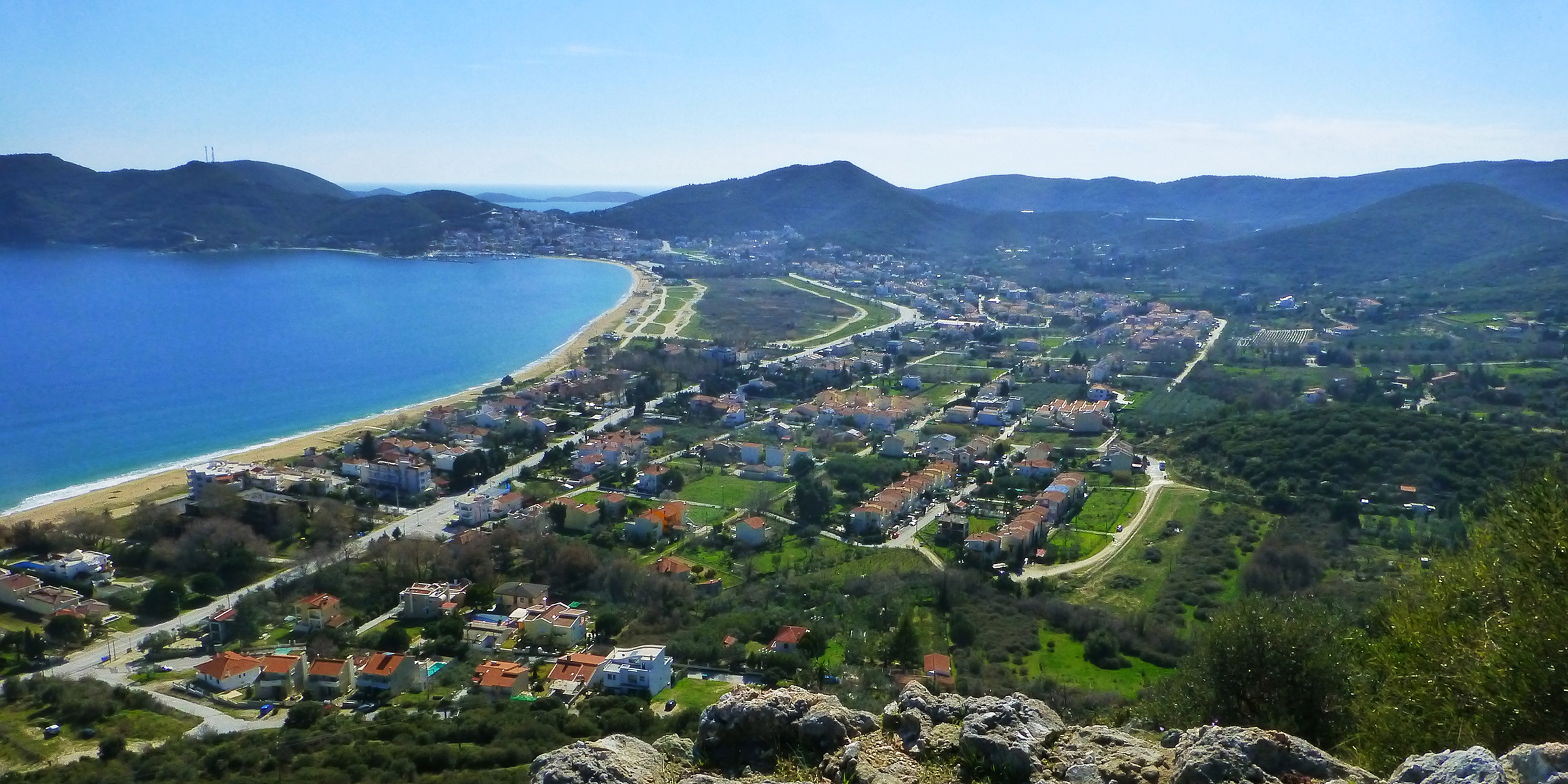
The climbing area of Irakleitsa is located southeast the village Nea Irakleitsa in the region of Kavala, its walls are by the sea, very close to the village of Nea Peramos.
The distance of Nea Irakleitsa from the town of Kavala is 11Km and in the village one can find food supplies and clothing as well taverns, nightlife, etc. Nea Peramos offers similar facilities.
The first routes were climbed on 1982 because climbers previously used to prefer longer routes in the virgin cliffs of the mountains. On 1982, Alexandros Tsilogeorgis thought that the cliffs of Irakleitsa should be used by climbers for training, so with the help of the Greek Association of Climbing Clubs and a lot of local climbers, the first routes were bolted and climbed. Later on however, climbers established routes more and more difficult and Irakleitsa evolved from a training ground to a complete climbing field for climbers not only from the area but from other towns as well.
In the following decades, many new routes have been established (some of which are not listed on routes.gr), resulting in them being very close to each other or being variations of older ones, sometimes causing confusion. Due to the proximity to the sea, special attention should be paid to the existence or not of belays, hangers and pitons, as well as their quality.
Irakleitsa is characterized by good, solid and shapely limestone rock and there are many routes ranging from beginners’ levels to high difficulty levels and from 35m to 110m. In general, they are equipped with bolts, but sets of nuts and flexible cams in a variety of sizes will be needed.
The climbing area is divided in three distinct sections, “Remvi”, “Kokkina” and “Donti”. Of the routes that have been established, most are located in “Remvi”, while “Donti” has the fewest and also the shortest.
Many routes that were established as traditional have been bolted afterwards, so that they can be converted into sport routes, which seems to have led some climbers who disagree with this action to proceed with the removal of these bolts. Therefore, special attention and careful information are recommended before visiting the area. In the route descriptions, if the information available to us says were established as traditional and bolted afterwards, they will have a double designation, namely Traditional and Sport. But even in those that are only designated as Traditional or Sport, we cannot be 100% sure that this is the case.
Warning: All sectors of the Irakleitsa climbing area are adjacent to the sea, resulting in the erosion of permanently installed gear (bolts, hangers, belays). Corrosion is unpredictable and often not immediately visible, therefore there is a great risk to the safety of climbers, as is the case in any other coastal climbing area. Therefore, good and detailed information about the condition of the routes is essential before visiting there. Such information cannot be provided by routes.gr but only by the local climbing community.