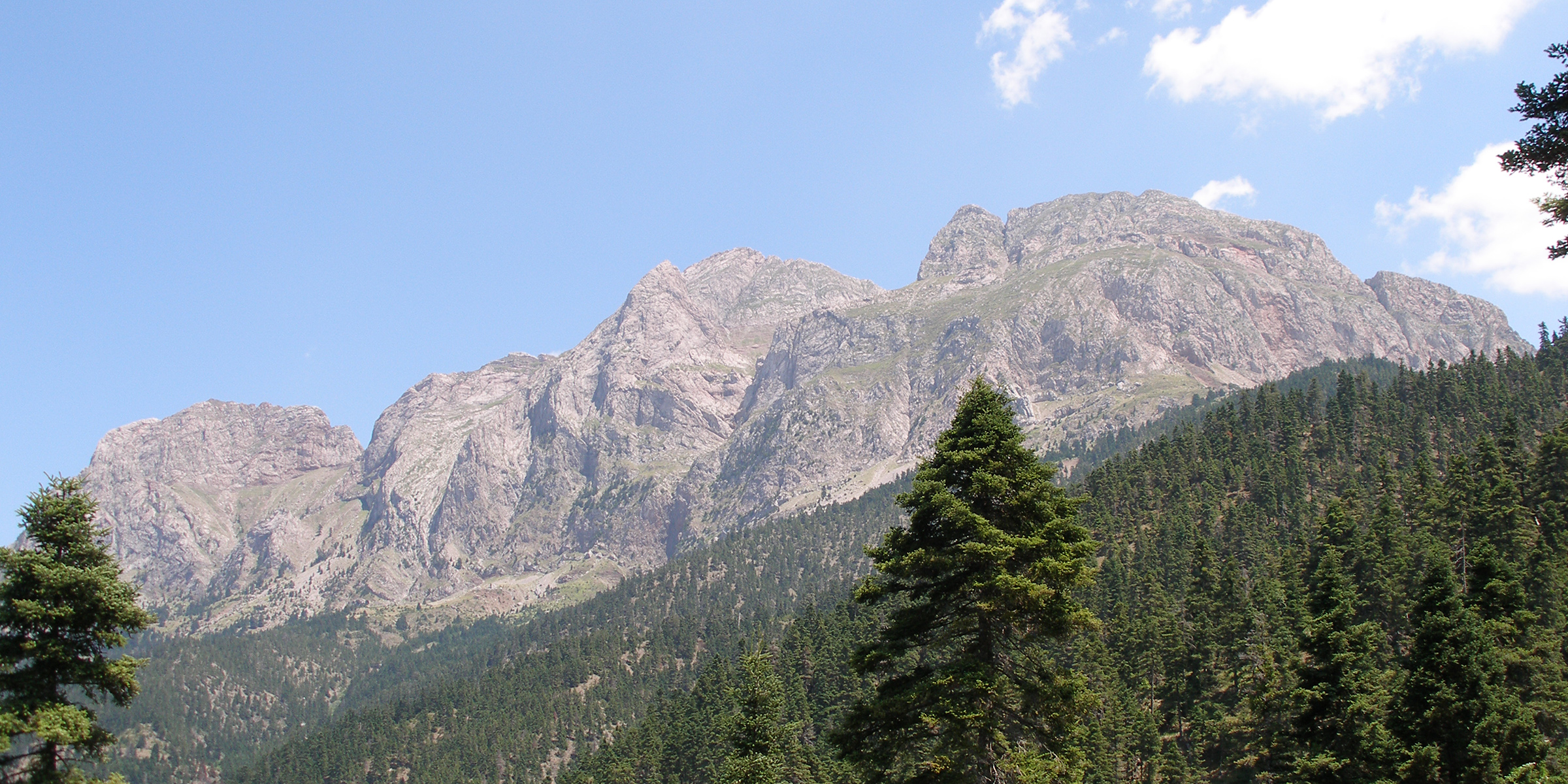
Vardousia (2495m) is Greece’s 7th tallest mountain and is situated on the border between the Phocis and Fthiotidas prefectures of Central Greece. The highest peak of Vardousia is Korakas (2495m), the largest village is Athanasios Diakos and it is separated from nearby Gkiona (2508m) by the impressive valley of the springs of Mornos river, which ends in a large water reservoir to the south of the mountain.
The mountain is made up of three distinct massifs, Korakas (2495m) with southern ridge, Western Vardousia (2348m) and Chomiriani (2294m). Throughout it the effects of past glaciation are clear, with steep rocky summits, ridges, as well as plenty of faces with scree, rock-steps, and couloirs, which the locals call “Skorda”. These faces are today among the ones favored by mixed climbers in Southern Greece.
Due to their location, Vardousia have not played a significant role in ancient Greek history, other than during the War of Independence where they served as a base for bandits. Similarly, in both World War II and the Civil War, the pass between Peak 2437 and Alogorachi was fortified with trenches by the resistance fighters, giving it the name “Meterizia”.
Visitors both in Athanasios Diakos and Artotina can immerse themselves in the exceptional nature that surrounds this wild mountain which is often referred to as the “Greek Alps”.
Access
Vardousia are rather isolated located roughly south of Sperchios, west of Mornos and north of the Mornos Reservoir. As a result, access to the mountain is only possible via two villages, Athanasios Diakos and Artotina, to the east and west respectively. Alternatively, the mountain can be accessed via the village of Koniakos to the east, which mainly serves hiking routes.
To approach from Athanasios Diakos, we exit the Livadeia - Lamia road at Skamnos and we continue West for 44Km, passing through Pavliani and Stromi. For Artotina the approach is possible from either Livadeia or Lamia and via the villages of Pentagioi and Grammeni Oxia, to the south and north respectively.
Accommodation
Besides the villages there is also the option for accommodation in the POA and EOS Amfissas mountain huts of Pitmaliko, at an elevation of 1950m, which have a total capacity of 78 beds and require a hiking approach via Athanasios Diakos, of a minimum of 3 hours in the winter.
Climbing history
Vardousia are one of the most important centers of development for alpinism in Greece, with over 140 routes varying in difficulty from PD/M1 up to M5+ and with an individual height of 50m to 8000m. Most of the faces of Vardousia have north or west orientation and the primary rock type is limestone.
Vardousia offers mainly mixed terrain with a wide range of difficulties, as well as many easier winter trekking and scrambling options, however, the purely rock-climbing routes are few. Popular are the characteristic mixed lines of medium height and difficulty such as “Paranoid androids” (III+ 4 M4 A1, 200m) and “Professionals” (II+ 3 M3, 240m), in the broader Korakas massif. When conditions allow it, the long routes of Skorda Mousounitsas such as “Korre - Chatzirvasani” (III 4- M2+, 950m) return to the forefront. At the same time, classic alpine routes of a trekking character dominate the imposing peaks of West Vardousia, but between them also hide incredible big wall opportunities.
The limestone of Vardousia is of widely varied but generally poor quality and as a result the difficulty of mixed routes is highly dependent on snow-cover. Yet, the routes are still climbed traditionally, with a focus on nuts and pitons, but also generously anchoring on snow and ice. Many popular adventure routes require parallel move, traverses and rappels.