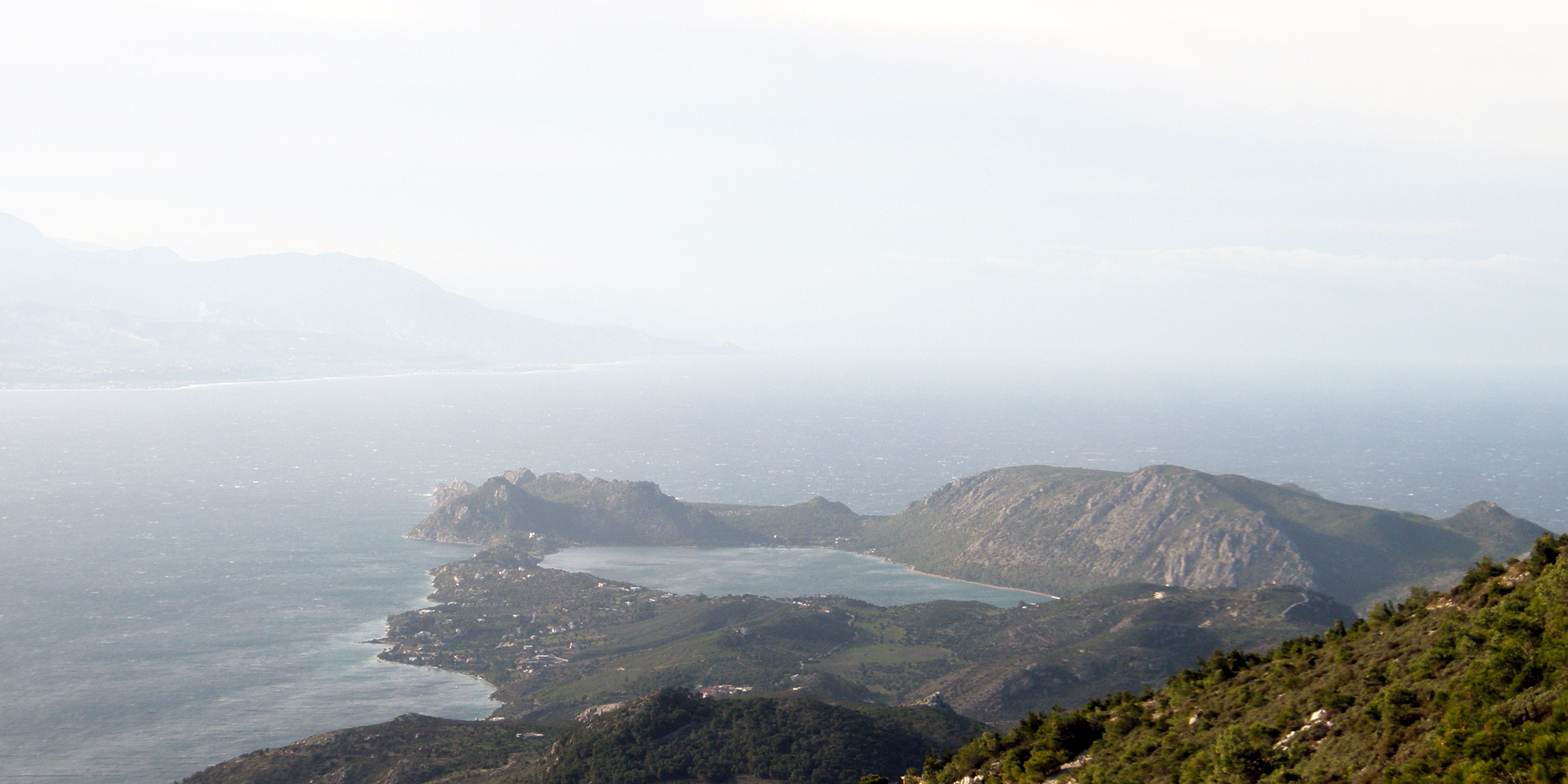
Heraion Lake is a 2Km long natural lagoon which is situated at the southwest tip of the Perachora peninsula, near Cape Melagkavi, in the Corinth prefecture. The lagoon was known since prehistory with relevant archeological findings, as well as being mentioned in the myth of the death of Gorge, daughter of Megareas.
Above the lake dominates the rocky peak of Kliskas (269m). At the limestone crag of Kliskas there are 17 routes, 6 of which are traditional, of difficulties from IV+ to VII-, as well as 11 sport climbs ranging in difficulty from 5c to 6b and with heights of 15m up to 110m. The crag has a southern orientation and is at a low elevation, thus it can be extremely hot during the warm month. To repeat any of the sport routes, 10 quickdraws and a 60m rope are required, while none of the traditional routes have equipped belays.
Access
Access to Heraion Lake is simple and made possible from Loutraki and via the rural road for Perachora. Parking is available at the taverns of the Heraion settlement at the east side of the lake, with the crag being approachable with a steep hike of around 5min on an unknown quality path.
Climbing history
The development of routes at Heraion Lake may have perhaps begun earlier, since Geraneia were a climbing destination during the post war period. The oldest recorded routes are a result of the effort of A. Avramopoulos and K. Kladis in 1979, who established 3 lines. Avramopoulos would return after 19 years, this time with G. Spinos, to complete the route “Difficult exit” (VII-, 110m).
The bolting of the sport routes was completed during the winter of 2021-2022 by T. De Mazière, the couple K. and A. Bečan with their son Aron and with the financial support of local businesses. In 2023 the first new traditional route in 25 years was established by Nikos and Simos, who returned in 2026 for another new route.
The sport climbing routes at the Elephant sector were established at the same spot as the old traditional routes; consequently, the lines partially overlap, and the character of the traditional routes has been compromised. Apparently, this happened because the climbers who bolted them, with the financial support of local businesses, did not first take care to inform themselves about the history of the sector, respecting a tradition that is known worldwide.
Warning: Due to the proximity of the crag with sea water and its corrosive effects, increased attention is required during your visit.
