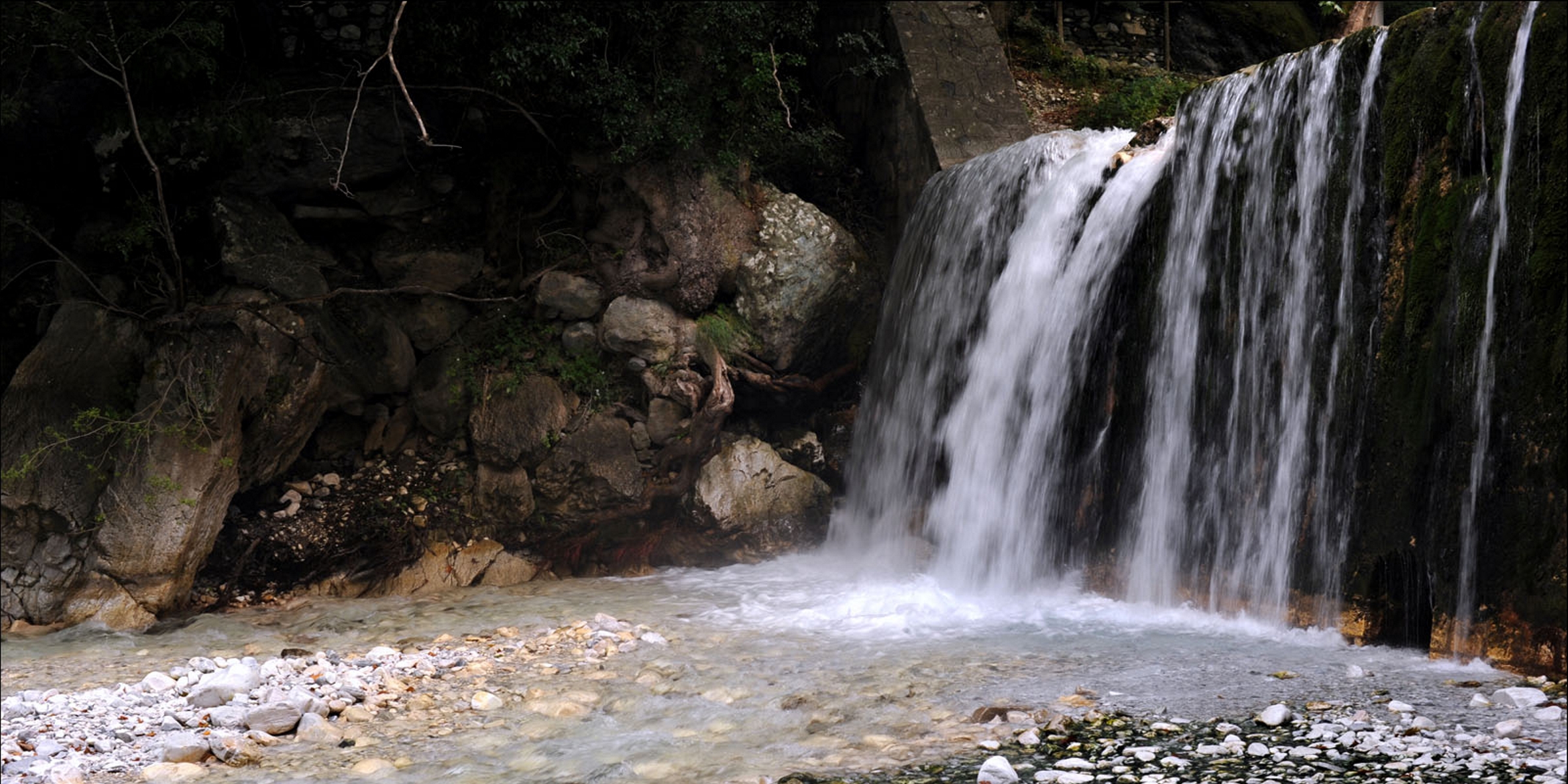
Loutraki is a village of around 1000 inhabitants located at the foot of mount Voras, on the plain of Aridaia, in the Pella region of Macedonia. The village is closely associated with the nearby Pozar hot springs, around which the modern settlement has gradually expanded.
The hot springs, together with the lush forest surrounding the village, provide excellent options for rest-day activities. Another point of interest is the church of Agios Ioannis, located in the abandoned settlement of Ano Loutraki.
At the gorge Galana Nera of Loutraki, 13 routes can be found on the mixed quality limestone, primarily sport climbing, with difficulties from V up to VII+, and a length of 25m to 700m. Besides two traditional routes, the remainders are all bolted multi-pitch climbs. The southern orientation and the low elevation make the gorge ideal for climbing during the winter months. To repeat any of the 11 sport routes, a 60m rope and 15 quickdraws are required.
Access
Loutraki is a 32Km drive from Edessa and can be reached via a provincial road passing through the villages of Sotira and Apsalos. The rock formations of Galana Nera are visible at the eastern end of the village. Follow signs toward the chapel of Agios Nikolaos, where the access trail to the gorge begins.
Climbing history
The first complete climbing route of the area was the imposing “Ridge of Hector” (V, 700m) which follows the prominent formation rising from the base of the gorge. It was established in 1996 by V. Galanis and Chr. Chaldogeridou.
Sport climbing development likely began in the late 2000s, following the completion of the traditional route “Echo in chaos” (VII A1, 110 m). The crag was bolted with the contribution of P. Nikou, Th. Tsopanidis, N. Giantsis and others.