The first ascent of the route “Archimedes” (V, 185m) was realized on 19/8/1977 by D. Hasse - H. L. Stutte - H. Magdefrau.
This is one of the most popular cracks in Meteora, with hundreds of repetitions every year, and we can say that now is a “classic” route.
The line moves mainly inside the huge, open chimney, which tears the tower in two and offers a spectacular exit at the top.
Due to its relative ease, it is suitable for familiarization with the chimneys of Meteora, as long as we take into account that it is still a route with long fixed belays that require composure as well as knowledge of placing removable gear in exposed places. Also, due to the depth of the crack that provides shade, it is relatively cool, therefore suitable for climbing even on a hot summer noon.
In the late 1990s, the German climber Detlef Augustin (or Gustl to his friends) associated his name with the route more than anyone else, having climbed it dozens of times, while also making the first solo ascent without the use of any kind of protection. And all this, while he was already a retired middle-aged man!
For the 1st pitch (III, 40m) we climb an easy slab with large cobbles, but without the possibility of using protection, permanent or removable. The belay is done on a ring.
For the 2nd pitch (III, 45m) we continue in an open gully at the beginning, which gradually narrows so that we can climb it as dihedral. The pitch does not have permanent bolts, but can be secured with large nuts and friends. The belay is done on a ring.
For the 3rd pitch (V, 25m) we follow an easy part in the direction of the narrow chimney, which we can enter either dihedraly (looking out), or with our back to one wall and feet opposite. The pitch has 2 permanent bolts on the left wall (looking out) and can also accept large friends (Camalot #5), which are not considered necessary by all climbers because the pitch is short, low rated and has 2 bolts. But without the use of those large friends, it requires composure and familiarity with chimneys. The belay is hung on 2 rings, one old and one new, and we must not trust the old one in particular.
For the 4th pitch (V, 30m) we move inside the chimney, initially passing large wedged stones, having the gap under our feet and continuing inside the crack until it becomes narrow as a shoulder. The pitch has 1 permanent bolt. The belay is done on 3 rings. This is the most impressive pitch of the route, because of the beautiful chimney, the feeling of an abyss under the feet and the view offered by the great height at which we are.
For the 5th pitch (III, 45m) we continue in an easy part, moving at the top and above the crack, without the possibility of using any kind of protection, permanent or removable. The belay is done on a ring.
After completing the route, the return is made using the rappels on the east side of the tower. But there are other alternative rappels, one of which descends the impressive west wall, to the right of the crack (as seen from the ground), but it is not recommended to attempt this unless followed by someone who has done it before, or unless you have received detailed information and at the same time be quite experienced climbers.
Note: The sketch of the route is a two-dimensional representation of the line as it appears when looking at the cliff from the northwest, that is, when we face the crack. This illustration, common to all route sketches, cannot represent our three-dimensional movement within the crack, where in the first half we move inwards, then outwards and finally over the top. Perhaps a sketch of the route as it would look from the west or north would be better, which is unnatural since we would have to be able to see through the rock, so it would confuse anyone who wants to climb it.
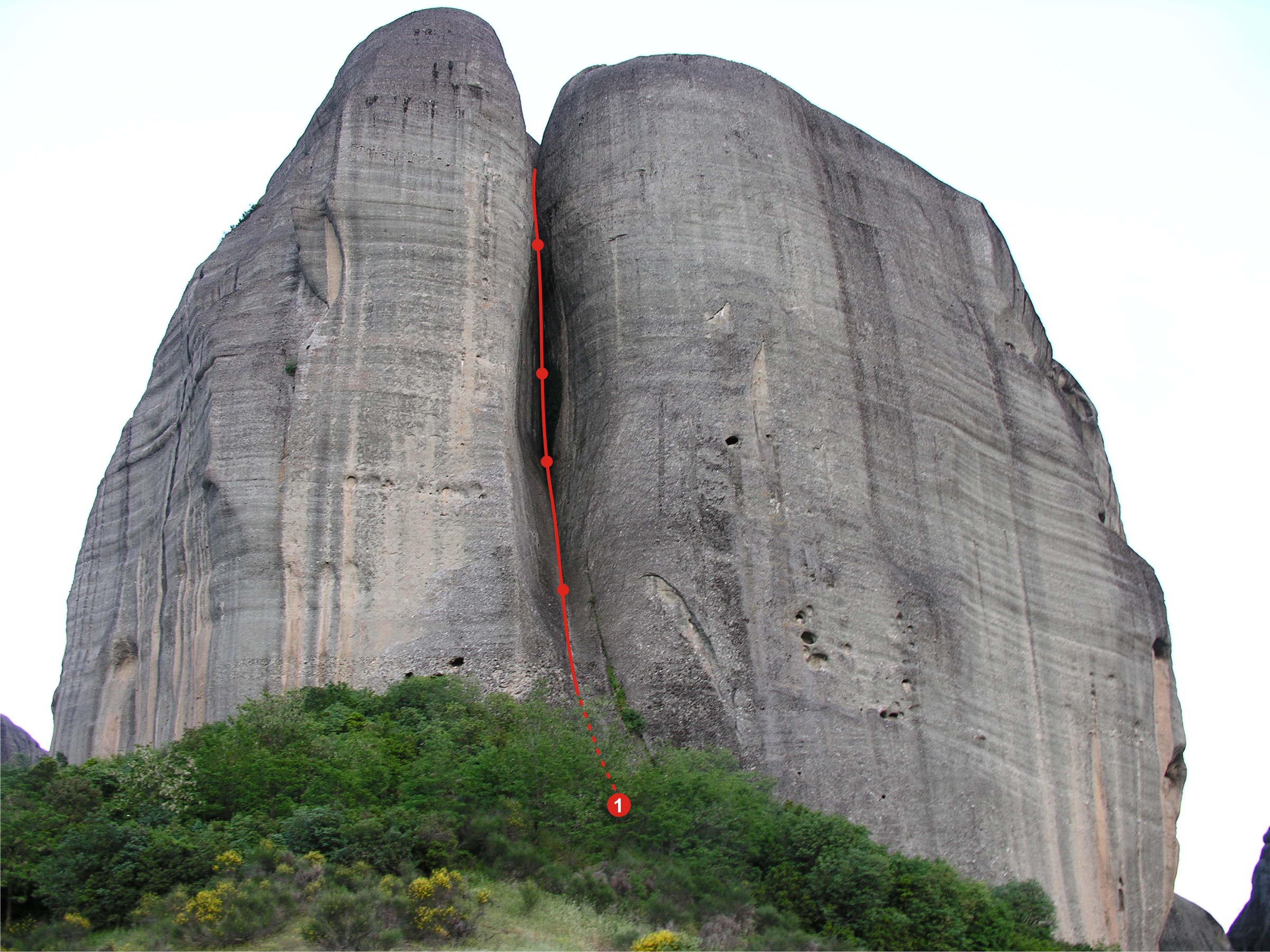
The route.