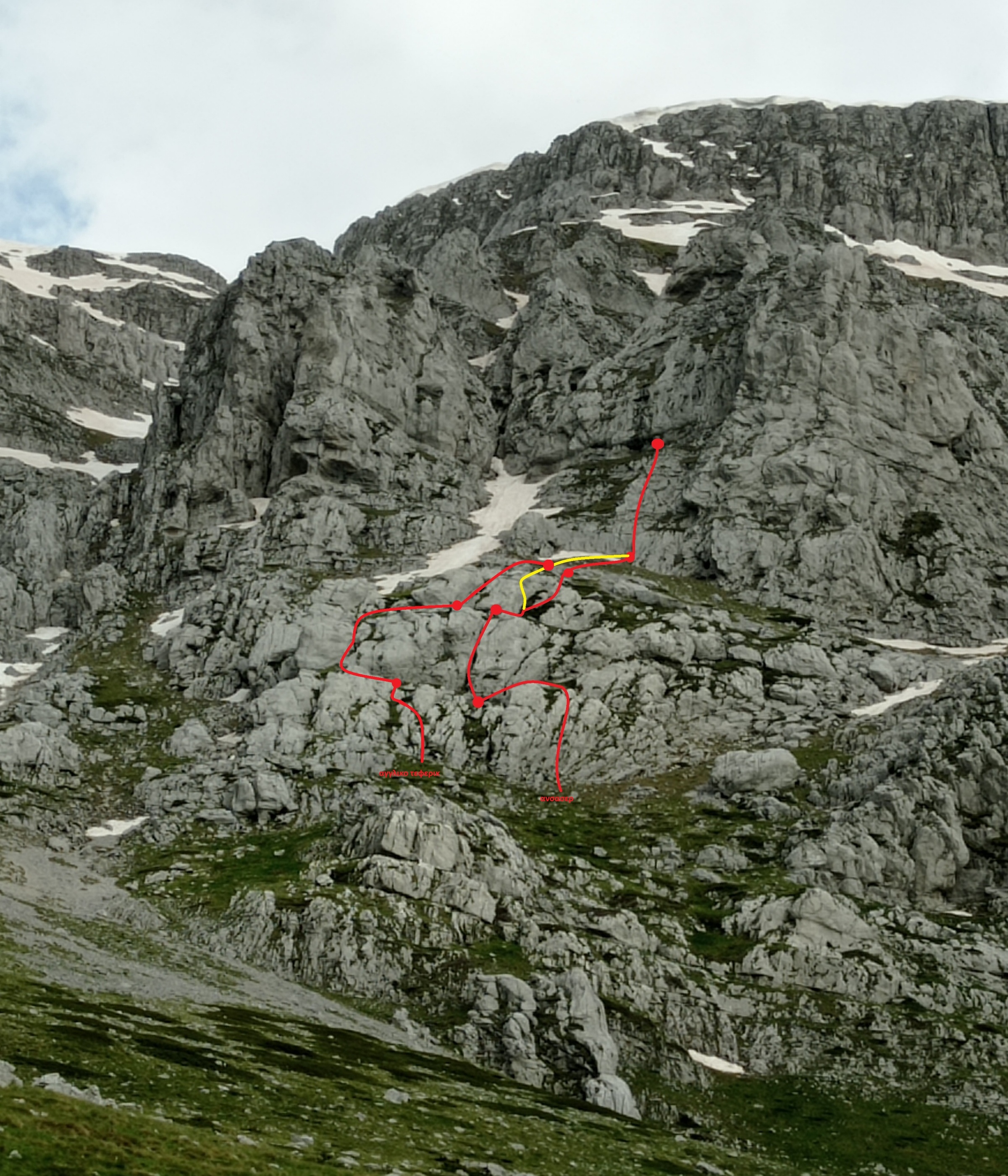
The first ascent of the route “Elevator” (V-, 200m) was realized in 1977 by G. Martzoukos - G. Katrivanos - K. Valianos - K. Delfos - G. Antonakopoulos.
The first repetition of the route was realized by Tr. Adamakopoulos - V. Chatzirvasanis.
The line is frequently repeated in winter as well, featuring difficulties up to 60° M2.
The route begins at the rocks below the “Meniscus” tower. It comprises a lower section of three pitches and an upper section of another three. These two parts are separated by a large ledge at the point where the tower begins.
For the first pitch (V-, 45m), we start on a slab that becomes more difficult towards its end. This section is well-protected with cams and nuts. We then emerge onto a ledge. From the ledge, we bypass the next positive slab on the right via a grassy gully that leads to a terrace. From there, we walk left to the base of the next pitch’s chimney, where we set up a belay on a freestanding block.
For the second pitch (IV+, 35m), we follow the distinctive chimney for its entire length. The first ascensionists in 1977, rated it III+. By modern standards, the exit is graded IV+, and the moves throughout the pitch are no easier than IV-. The chimney offers good protection in the first half but almost none in the second, narrower half. After the exit, the belay is set up at a massive, distinctive monolith, which is slung with the rope.
For the third pitch (IV-, 30m), we start to the right of the monolith and enter a grassy dihedral next to a large rock mass. We then bypass the rock mass on the right, moving across grassy, low-angle terrain. Finally, we reach the ledge, where we set up the belay at a monolith.
The route, along with all its variations, traverses the ledge (I/II, 40m) and continues into the second part.
For the 5th pitch (IV, 40m), we start on a small chimney. We then move onto a slab and continue across easy, grassy terrain to the base of the dihedral of the next pitch, where we set up a belay using cams and nuts. The slab is quite loose. The entire pitch can be bypassed on the left via easy, grassy terrain.
For the 6th pitch (V-, 40m), we continue on a slab and a dihedral featuring an old piton. We then reach a slab section, which holds the crux. Afterward, we continue over positive terrain to a belay station set up on gear and a thread.
The final pitch (III+, 30m) leads to the exit pitch of “Meniscus” and allows the climber to choose any of the descent routes.
The gear required to repeat the route and its variations consists of a set of nuts, a set of cams (up to Camalot #3), and optionally a few pitons and a hammer. The rock quality is generally very good.
Access to the base of the route from the refuge (taking about 20min) involves traversing the slope almost horizontally; we pass beneath the base of the “Nestled” route, then continue the traverse to the right, to reach the base of the first section.
After finishing the last pitch, there are several return options. The quickest choice is to follow the “Meniscus” return cairns to the right. Alternatively, we can head left; there, we follow wild goat paths, cross two gullies, and reach the return cairn for the “Nestled” route. Finally, we can continue upwards, finding the easiest path to the summit via simple passages and ledges, much like the route's first ascensionists likely did.
Two variations have been established on the lower section. The first, by Giounis - Sfyris - Katsiou, is a more difficult variation of the third pitch. The second, by Giounis - Vellas, comprises three new pitches leading to the ledge.
Giounis - Sfyris - Katsiou variation
This is a variation (V+/VI-, 30m) of the 3rd pitch, established on 1/6/2026 by D. Giounis - K. Sfyris - F. Katsiou. For this variation, we continue up the dihedral to roughly the midpoint of the rock formation located to the left. There, we will find an overhanging shoulder crack that takes good protection with friends (Camalot #1 and #2). We move from the crack onto the rock formation itself and continue straight up, negotiating a final, airy move on hand-holds, to reach the ledge, where we set up the belay on a monolith.
“English cable car” variation
The “English cable car” variation (VI, 90m) was established over two attempts, on 6/6/2026 and 21/6/2026 by D. Giounis - I. Vellas, and comprises three new pitches. The name was chosen because the climbers ascended the demanding 3rd pitch using the “headpoint” technique, rappelling down to test moves and gear placements beforehand.
For the 1st pitch (V, 30m), we start about 10-15m to the left of “Elevator” with an easy move up to a grassy ledge, where a short, technical section on a positive wall (V) is encountered, followed by continued movement across grassy terrain. Next, we traverse left into an easy, aesthetically pleasing, glacier-carved dihedral, leading to a ledge where the belay is set up using trad gear.
For the 2nd pitch (IV, 30m), we start further left on a grassy ramp and continue up a dihedral (IV) until reaching the ledge. From there, we move right toward the distinctive positive-angled slab of the 3rd pitch, where the belay is established using trad gear.
For the 3rd pitch (VI, 30m), we begin with continuous moves on a positive slab, featuring nonexistent footholds but large handholds, and place protection using cams (Camalot #2 and #3). We then enter the crux; here, handholds are limited to a continuous finger crack, footholds rely entirely on friction, and protection consists of very small cams (smaller than Camalot #0.4) and nuts. The difficulty subsequently eases as we traverse a dihedral and a positive slab, finally reaching the ledge where we set up the belay on a monolith.
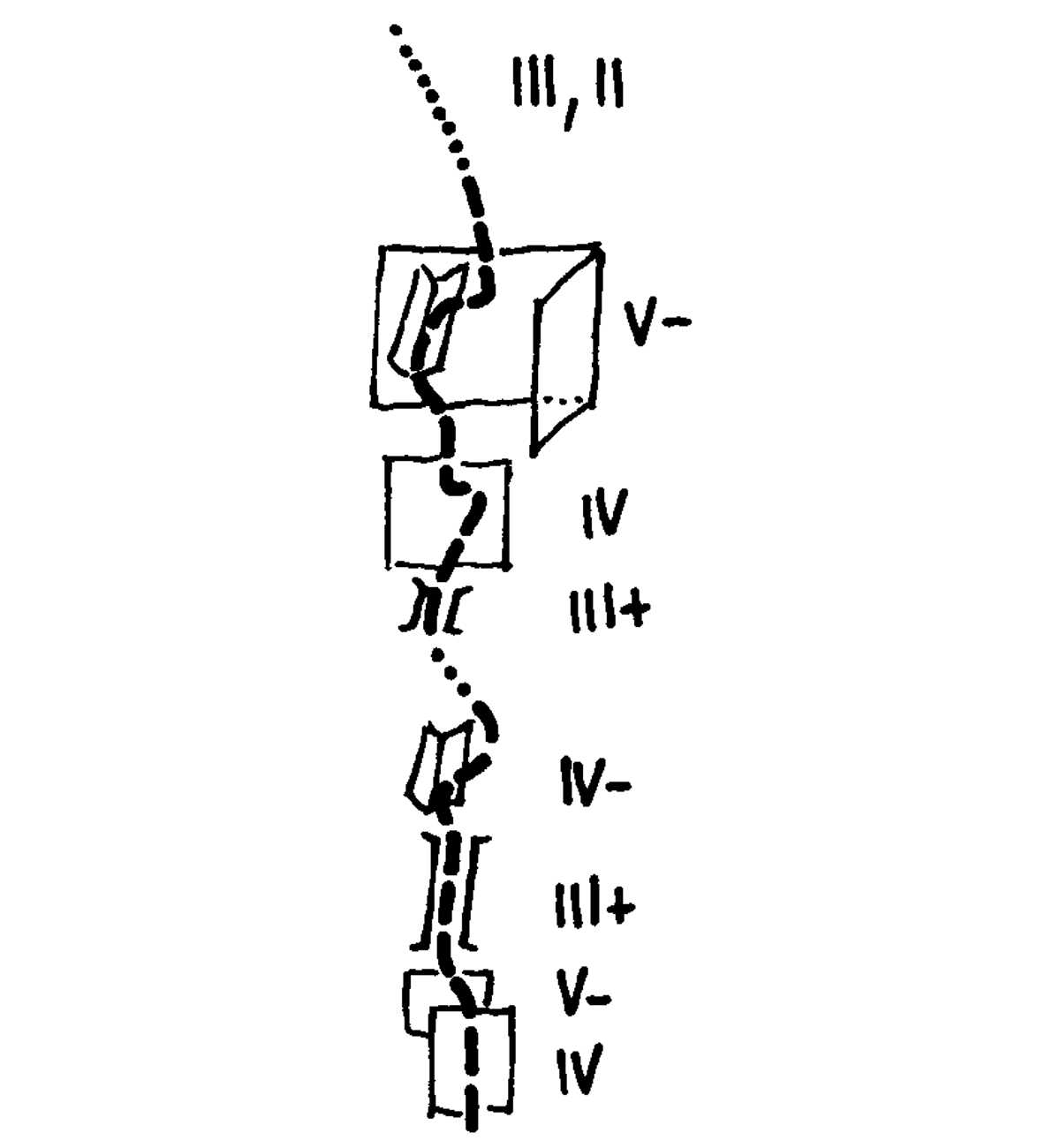
Sketch of the route where [1] “Elevator”, [2] Giounis - Sfyris - Katsiou variation, [3] “English cable car”.
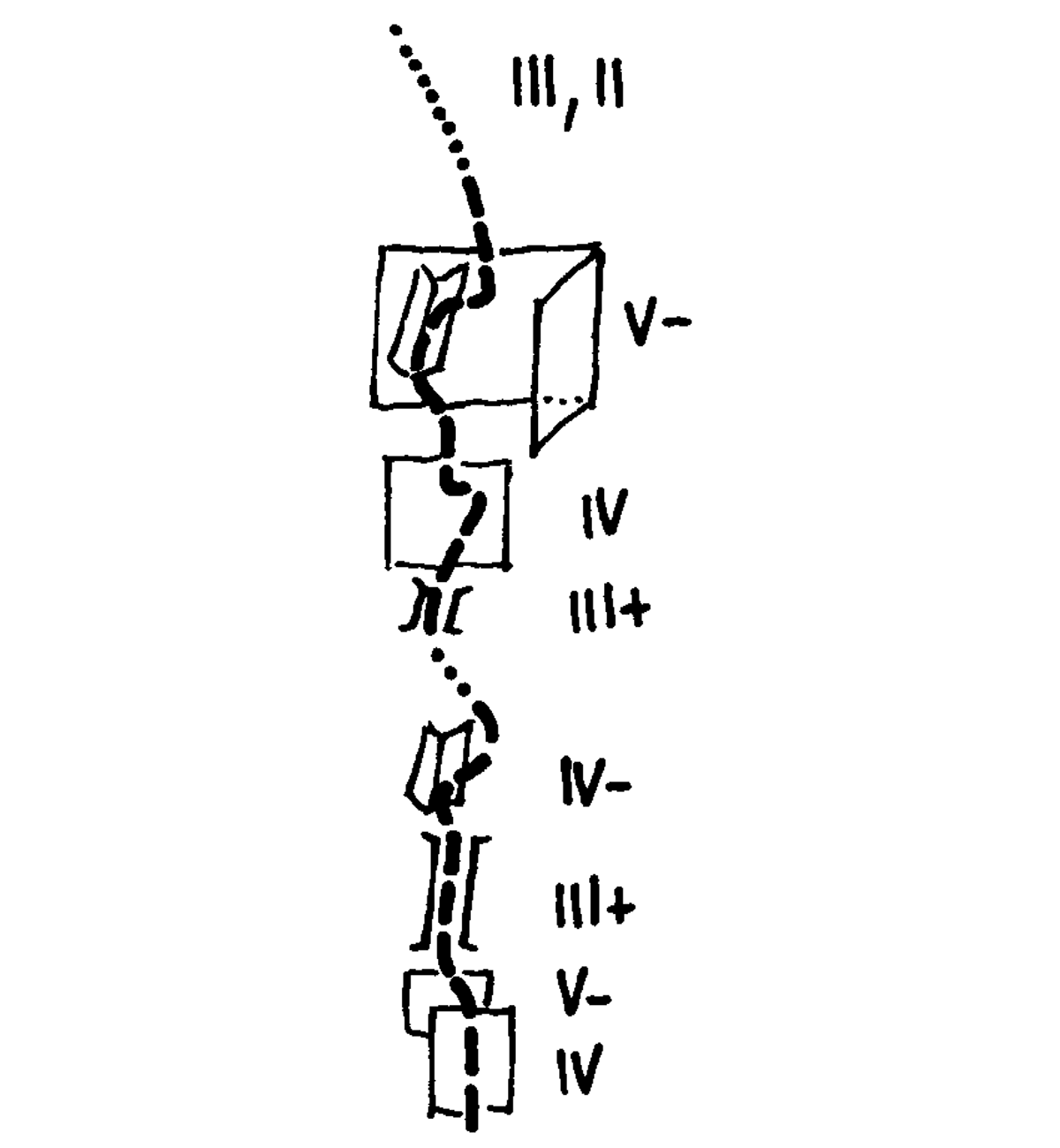
Old sketch of the route.
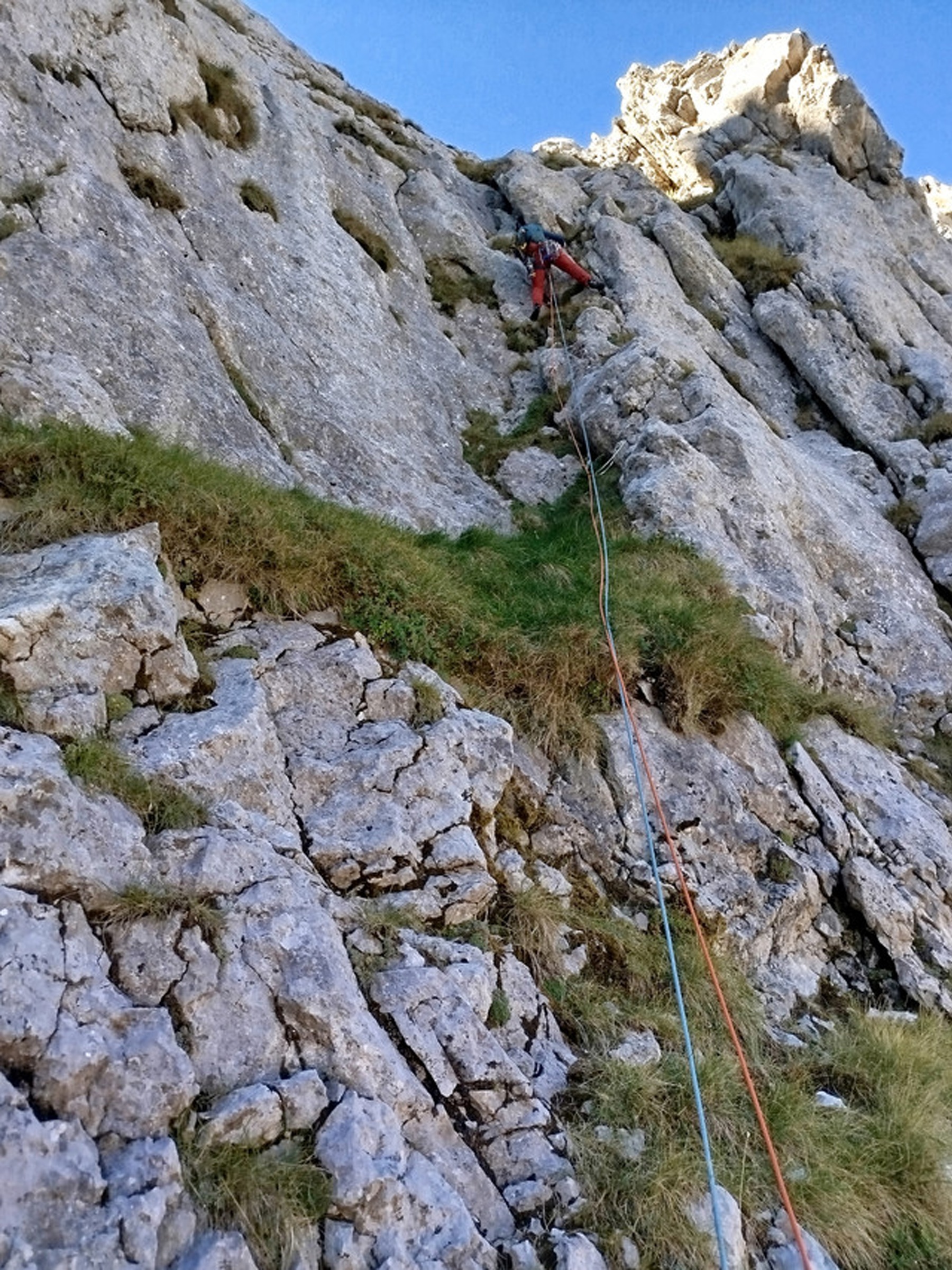
At the exit dihedral.