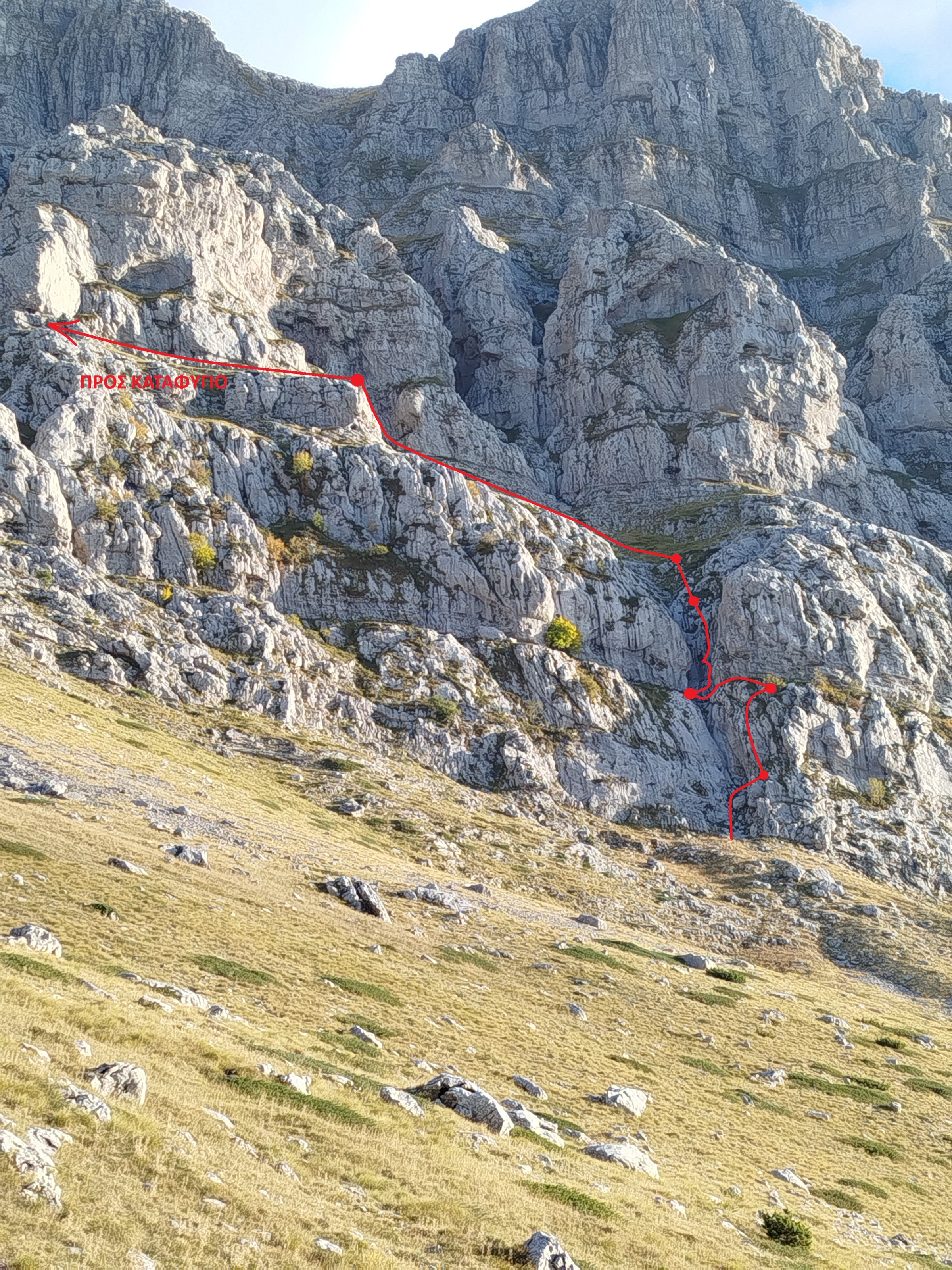
The route “Panther's gully” (VII-, 240m) was established on 10/11/2025 by D. Giounis - Ch. Zonios.
The line was climbed during an attempt to locate an older route and moves on the rock formations below the first major ledge. Specifically, it follows the first of the two large couloirs visible from the last spring named Krouna, at 1800m, before the refuge.
For the 1st pitch (IV-, 30m), after reaching the start of the gully, we ascend easy, rising terrain with broken rock until we reach a short, tricky section (IV-) involving a large boulder. We bypass the boulder on the left to enter the gully itself. There, up and to the left, we will see a distinctive water runnel, but we continue to the right over an easy, slightly overhanging move (IV-) to reach a grassy ledge, where we set up a belay using small tree trunks.
For the 2nd pitch (VI, 30m), we head toward the arête, where we immediately encounter a short, overhanging section (VI) with good holds. The overhanging is protected from below using medium-sized cams (Camalot C4 #1 and #2) and, just before the move itself, a very solid large cam (Camalot C4 #4). After clearing this section, we continue along the arête over easier but grassy terrain, often offering no protection, until we reach a cluster of small trees and a ledge up and to the right, where we set up the second belay.
For the 3rd pitch (IV+, 25m), we continue upwards from the belay station over an easy, slightly overhanging section (IV) to reach a small grassy ledge. We then move left towards the gully. Via a traverse and a down-climb (IV+) we enter the cave, passing another grassy ledge (from which we could retreat on foot to the left) and setting up the belay on the left at a large wedged rock with pro.
For the 4th pitch (VII-, 40m), we move right to begin continuous climbing on a solid, positive-angle slab with good holds (V+), placing cams for protection near its end. We then traverse left across smooth rock with small, hard-to-protect holds (VI), aiming for the ledge next to a distinctive hole. There, we find a placement for a cam and, slightly further right, the first piton, marking the start of a continuous sequence: initially a slab with small holds, followed by an overhang with larger holds (overall grade VII-). A few meters past the first piton, we can place small cams, and just before the overhang begins, we encounter the second piton (which protrudes slightly); otherwise, protection is non-existent or not particularly trustworthy. Immediately after the crux, we reach a ledge where we can place protection using cams and nuts. We then continue up a grassy section (IV), largely unprotectable, to arrive at a distinctive small cave, where we build an anchor using a spike and gear.
For the 5th pitch (IV+, 35m), we move right from the cave across rising, grassy terrain to reach two pleasant, solid, positive-angled slabs with large holds. The slabs are separated by a short grassy section and feature enjoyable moves (IV+), eventually leading out of the gully onto grassy ground with large rocks, where we set up the belay on a small rock outcrop.
For the 6th pitch (III+/IV-, 80m), we walk to the left to find the first ledge. From there, we continue left until we reach a small gully (rated III+ to IV) that must be climbed to reach the next ledge, from where we simply walk left until we arrive at the “Meniscus” tower.
To repeat the route, you need a set of nuts, a set of cams up to Camalot C4 #4, and optionally some pitons and a hammer.
The approach takes about 40min from the refuge. You first descend towards the Krouna spring and then leave the path, heading towards the gully.
To return from the base of the “Meniscus” tower, we will move from the ledge towards the start of the “Nestled” route. From there, we will descend slightly and continue towards the refuge (15 - 20min).
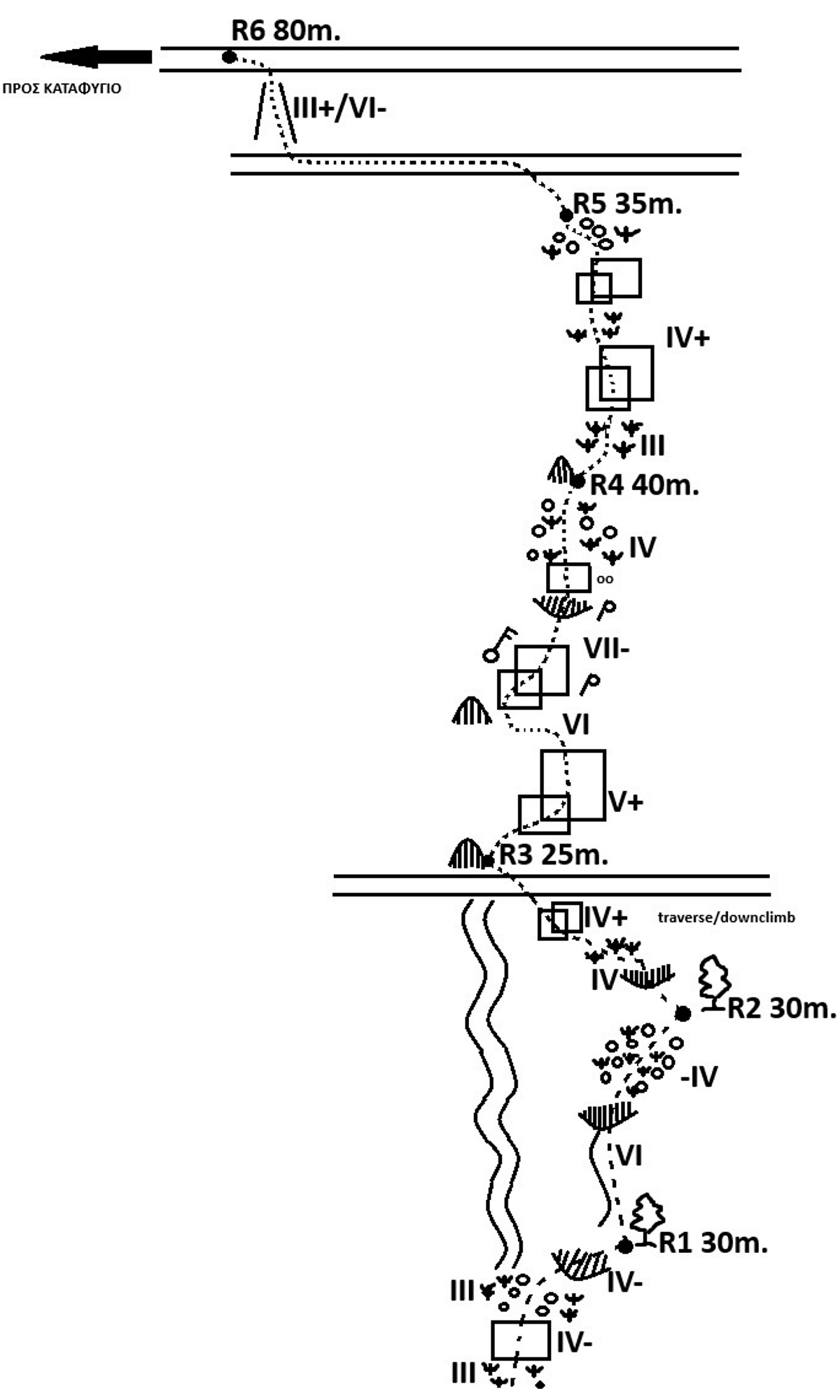
Sketch of the route.